THE PHILATELIC JOURNALISTS

Monday, November 10, 2014

PHILATELIST KALEIDOSCOPE


PHILATELIST KALEIDOSCOPE

by Dr Bibhudatta Mishra & Shanti Swarup Rath

clip_image001

"PHILATELIST KALEIDOSCOPE" by Dr Bibhudatta Mishra & Shanti Swarup Rath : Pages 160 :  Price - Rs 400.00 (hardbound ) and 350 (softbound) Published by Swarna Associates, Bhubaneswar : Book available with the Publisher Contact email : philakale14@gmail.com or swarna.associates@gmail.com

The book has 10 chapters touching thematic areas meant for youth collectors who are in collection of postage stamp but ignorant about the hobby. Beside the book will help general readers & students providing general knowledge

The first chapter Stamps collection-Rainbow of diversity focuses Introduction with short description about philately, First stamps of the world, UPU etc. In addition, outline the categories in philately, types of collectors, types of accumulator etc.

The second chapter’sCheapest mode of Communication-Popular postal stationary & services speaks notes on various postal heritage buildings with stamp images, Indian Postal services such as Money order, National savings scheme, Postal Life Insurance, India Post Freighter, Postal Index Number, Speed Post, Modern Postal System etc. Further, Postman and Types of Letter boxes, Types of postage stamps, Postal Stationery used in India were given with factual information.

The Third Chapter’s Amateur Collectors-Beginner’s Tip paid attentions on what to study in stamps, what to collects, cancellation & types of cancellation etc with example of postage stamp or symbols.

The Fourth Chapter begins with India Pride such as National symbol, National song, National Flag, National Bird, National Flower, National Fruit, National tree, National Sports, National Land animals and many more. An interesting depiction in this chapter is all the Bharat Ratna Awardee in two pages with postage stamps, Noble laureate, Param Vir Chakra, Magsaysay awardee, oldest newspaper, oldest observatory etc. All the unit and subunit of the chapter has list of stamps released by India Post on the same content. An unit of this chapter describe the Fascinating Indian Stamp Facts.

The Fifth Chapter has the description of Mahatma Gandhi-Father of the Nation. The chapter also presented with list of Miniature Sheet, Cancellation & se-tenant published by India Post on Gandhi.

The Sixth chapter focuses on Rastrapati Bhawan, Loksabha & Rajya Sabha, President & Prime ministers (Name sequentially with period in the position. The chapter decorated with all the stamps, se-tenant & miniature sheet.

The seventh chapter titled “Cruising the Magnificent jungle Safari-Wild, domestic and Aquatic Animals” presented with briefing about all the wild animals with postage stamps & stationery, Domestic animals & fish, sea shell, amphibians etc. The chapters end with brief about 10 National Parks on which postage stamp released.

The Eighth chapter comprised of “Wonders of Indian Birds-Sweeping the sky with tiny wings”describing all types of bird stamps such asdefinitive bird stamps, conservation in bird, raptors, Antarctica birds, Migratory birds and butterflies.

The ninth Chapter has the heading “ Valley of Calm Trees & Plants-Faded Petals from a beautiful Bouquet” presented beautifully all types of tree i.e large tree, flowering plants, Perfumed flower, medicinal flowering plant, medicinal plant, orchids, mangrove plants, Himalayan Flower etc. with scientific and local names of the plants.

The Final chapter endorsed “Voyage to enlightment-Spiritual, religious and Holy routes for Salvation” all the religions Hinduism, Islam, Christianity, Jainism, Buddhism & Sikhism, pilgrimage places, festivals in stamps and their importance for human mankind.

The book completed with Bibliography & web sources from where reference were taken. Each chapter consist of Phila Quotes by famous personality with stamp images, Phila Facts, List of Miniature Sheet, Pictorial Cancellation, se-tenants, Sheet lets, Maxim card etc.

The 160 pages (hard & Soft bound) book published by Swarna Associates Publisher from Bhubaneswar is priced at Rs 400.00 (hard) and 350(soft). This handsome books feature more than 500 stamp images, souvenir sheet, maxim cards, booklet, postal stationery etc. The book has received an ISBN number. The publisher may be contacted for this book at E-mail: philakale14@gmail.com or swarna.associates@gmail.com

Recent Books on Philately


PHILATELIST KALEIDOSCOPE
by Dr Bibhudatta Mishra & Shanti Swarup Rath


"PHILATELIST KALEIDOSCOPE" by Dr Bibhudatta Mishra & Shanti Swarup Rath : Pages 160 :  Price - Rs 400.00 (hardbound ) and 350 (softbound) Published by Swarna Associates, Bhubaneswar : Book available with the Publisher Contact email : philakale14@gmail.com or swarna.associates@gmail.com
Philatelist Kaleidoscopes is an excellent book on postage stamps which reveals every aspect of philately in a very  interesting  and easy way . After going through this wonderful book  the reader falls in love with the world of stamps and understands the real meaning of tiny pieces of paper which are the treasure of knowledge. The authors have presented the book with some very  interesting chapters that attract a philatelist as well as  a general reader. The best part of the book is its style of narration of various  associated branches of philately and philatelic terminology with the help of images  in such a simple way that a reader can well understand the hobby and how to start it in a systematic way.
PHILCENT INDIA 2014 –15
by Prem Chand Jaiswal


Philcent India 2014 -15 Guide Book by Prem Chand Jaiswal published by Philcent Publications, Kolkata -  Pages 128 Price - Rs 500 (Post Free in India) , - $25 for all foreign countries inclusive of registered airmail bookpost & Packing – For more details Contact : philcent@rediffmail.com   Ph. 9831598560  ; 033 - 65294756 – Distributed by Madanchand Darda eamil – madanchandra@gmail.com  Ph. 7667730851


The recent Book PHILCENT INDIA 2014 – 15 by  renowned Professional Philatelist  of India Mr Prem Chand Jaiswal is a complete guide book to Indian Philately. The book includes main chapters on  British India, India Post Independence and  Indian Princely States. The book has covered all related topics of Indian Philately. Collectors would find this book very useful.  I recommend this book  to all philatelists and stamp lovers. This book will be an asset for the libraries of  Philatelic Societies and stamp Clubs.
Indian Antarctic Expedition Philatelist’s Guide
By Abhai Mishra


Indian Antarctic Expedition Philatelist’s Guide By Abhai Mishra - Pages 116 - Price For India  Rs. 1500/- postpaid. For foreign via paypal 50 euro postpaid Available at  : www.stampsofindia.com or contact Abhai Mishra  email : abhai_mishra@rediffmail.com
 A book titled "Indian Antarctic Expedition-Philatelist's Guide" by noted philatelist, Mr Abhai Mishra was recently released in Dehradun. The book traces the history of Indian Antarctic Expeditions through mails and letters carried with the expedition. It documents the Indian Antarctic postal history through cancellations, cachets, labels, envelopes, letter  heads, QSL cards, postcards used during the expedition. The book reveals very rare and lesser known facts of Antarctica. The book illustrates, hundreds of rare letters carried with the expedition and describes each and every Indian Expedition in detail.
The book has 54 chapters.These include historical perspective (with details about Dr Giriraj Singh Sirohi, First Indian to visit Antarctica and Dr Paramjit Singh Sehra, first Indian to winter over in Antarctica) , Various date cancellers used in Indian Antarctic Post Offices,Institutions managing the Indian Antarctic  Program, Indian Antarctic Expeditions,Indian Antarctic Stations ( Dakshin Gangotri, Maitri and Bharati), Lists of Commemorative stamps, special covers, Cinderella and booklets pertaining to Indian Antarctic Expeditions, Indian Antarctic Clubs, lists of QSL Cards used by the HAM operators  during the expeditions,, honorary postmasters of Indian Antarctic Post offices, Feats and Facts of Indians in Antarctica and List of estimated price of  Indian Antarctic Covers .

Year Book of Indian Philately : 2013
By Madan Middha


Year Book of Indian Philately: 2013  by Madan Middha Pages 271- Published by Vishesh Prakashan, Topi Bazar, Gwalior. Price Rs 300
The book covers information on philatelic events of year 2013. Award List of international exhibitions, forthcoming international exhibitions, Indian stamps, postal stationery, Army covers, Special covers and postmarks issued during the year 2013 have been listed in the book. Information on Postal History events, exhibitions, society news has also been included in the year book.
The “Year Book of Indian Philately 2013” is  available with Mr Madan Middha The price of the year book is Rs. 300 inclusive of postage in India.Readers may contact : Mr Madan Middha, Saket Vihar, Phalka Bazar, GWALIOR - 474 001. email : madan_middha@yahoo.co.in
Book on Tagore stamps and covers


Rabindranath Tagore and The Post Office - A Philatelic Tribute – By Dipok Dey
The book “ Rabindranath Tagore and The Post Office - A Philatelic Tribute “ edited by noted artist and philatelist Shri Dipok Dey has been published by Rammohun Library and Free Reading Room, Kolkata.
This book gives details with colorful illustrations of all the stamps along with First Day Covers, Postmarks, Souvenir sheets, Miniature sheets, special covers, special postmarks, Booklets, Maximum Cards, Picture Post cards ,  catch Covers etc.
The other details of the book are given below :

Rabindranath Tagore and The Post Office - A Philatelic Tribute Edited by Dipok Dey - Hardbound - Pages 64  - Price Rs 575.  - Published by Rammohun  Library and Free Reading Room, 267 Acharya Prafulla Chandra Road, Kolkata – 700009. email : rammohunlibraryafrr@gmail.com Ph. 033 – 700009 ( Please contact from 2PM to 6PM except Saturday and Sunday)

Tuesday, January 21, 2014

History of Indian Miniature Paintings Through Philately..


image

History of Indian Miniature Paintings Through Philately by Dr Satyendra Kumar Agrawal published by PHILAGOLD Publications, Pages 80,  Price   Rs 1200 / US  $ 25

History of Indian Miniature Paintings Through Philately is a beautiful   Coffee Table Book by renowned philatelist and philatelic author Dr Satyendra Kumar Agrawal. The book is based on deep research of different schools of Indian Art by Dr Agrawal. The study has been narrated through beautiful images of various philatelic items  issued all over the world. The book is divided into 14 chapters with details of paintings from different schools of Indian Art. The most attractive part of the book is its fine and rich printing. The book has been presented by the author in a very aesthetic way that on first sight it captures the attention of the reader.

The author has presented many stamps, special  covers, postmarks, postal stationeries  issued by India Post and other postal administrations of the world  on Indian Miniature paintings . Some of them are rare to see. This book will prove to be best companion for all the art lovers and I recommend it for the library of Art Schools and all educational institutions and to everyone who loves reading. For the philatelists it is a wonderful book as they will be amazed to see many rare philatelic items in the book issued on Miniature paintings of India. Of course those collecting stamps on paintings it is a complete guide to them and they will get every detail about Indian Miniature Paintings in this book.

The book is available with Dr Satyendra Kumar  Agrawal  : email rosephila@hotmail.com

About the author

image Dr Satyendra Kumar Agrawal is an eminent philatelist , well known cartoonist, science and philatelic writer. He has received many National and International Awards for his exhibit on “ Roses”. He authored four books, “ My Rainbow of Philatelic Articles ”,, “The Rose” ( A-Z of Rose Philately), Glimpses of Indian Mythologies in Philately” and Birth of Playing Cards”.


- Jeevan Jyoti

Year Book of Indian Philately - 2013 edition

Dear Friend,

It is a great pleasure to announce the publication of the 2013 edition of the “Year Book of Indian Philately” which is in the final stages of the preparations and is expected to be out by March 2014.

The Year Book has established itself as a very much sought after publication on philately with special focus on Indian Philately, by virtue of the contents it carries in every edition. Collection of serious and sincere texts and articles on a spectrum of philatelic subjects by learned authors, with lasting impact & universal appeal has made this Year Book, a must for every sincere philatelist’s bookshelf.

The recognition it has acclaimed at the International Philatelic Exhibitions is an undeniable proof of this fact. As a matter of a record the Year Book has won a medal at EVERY Philatelic Exhibition it has participated in so far !!! The latest are 2 in 2013, a Bronze at BRASILIANA 2013 at Rio de Janeiro, Brazil ; and a Large Vermeil at the MAPPEX 2013, Madhya Pradesh State Philatelic Exhibition held at Bhopal. Incidently the Large Vermeil was the highest medal awarded at the Mappex. Apart from this, Silver medal at the IPhLA 2012 in Germany, the World’s Largest & Specialised Philatelic Literature Competition also shines as a golden feather in the cap of the publication. We strive to continue this legacy with the coming editions too, including the edition under discussion, the 2013 edition.

The ensuing 2013 edition also reflects the tradition of being serious, sincere & interesting. The issue is supposed contains articles on important subjects like “Indo-Pak Philately”, “Azad Hind”, “Indian telegraphs”, “Gandhi 1948”, “ Indian Watermarks”, “Unusual Stamps” and the like, by our illustrious contributing authors, including regular features recording history, events & issues for the concerning year. The list is tentative but chances are for expansion of it.

Like last year, we have designed a special opportunity for our philatelic professional friends for inclusion of their advertisement in this edition too. This opportunity eliminates the total “cost” of the advertisement published in the Year Book. It follows.

We will provide the advertiser, copies of the Year Book editions (any of his choice, subject to availability), worth equal to the value of the advertisement he provides (T&C applied). This translates into absolutely no spending on account of the advertisement published in the Year Book. The advertiser will have the opportunity to recover the entire cost of the advertisement by selling the copies of the Year Book allotted to him under this unique offer.

This arrangement makes the offer an undeniable opportunity for the advertisers to advertise their services / products in this world class journal with a universal appeal. Your advertisement in the Year Book of Indian Philately will reach a large number of serious and capable segments of the Philatelic fraternity the world over and will be preserved as a solid reference for the times to come? In every sense of the word this is a unique & unparalleled opportunity for an advertiser of any reputed product or service, philatelic or otherwise.

And yes, this will help us, greatly, to make the publication still better.

We are sure you would not let this opportunity go. If you have any other query about this, please do not hesitate to mail.

Looking forward for a positive, encouraging and prompt response from your end.

Thanking you, sincerely,

Madan Middha

Publisher / Editor email : madan_middha@yahoo.co.in


Tuesday, August 6, 2013

Thailand 2013–World Stamp Exhibition


image_thumb10

On  2nd of August Thailand 2013 World Stamp Exhibition opened its door to the philatelists from all over the world. World Stamp Exhibition, Thailand 2013 is being held during 2 – 14 August 2013 at Royal Paragon Hall, 5th floor, Siam Paragon Shopping Center under the patronage of H.R.H. Princess Maha Chakri Sirindhorn .

Indian Participants


In this exhibition following entries are from India.

4018    1494-1498    Virendra Sharma   4  British India Queen Victoria Postal Stationery

7111     1704-1708    Birajlaxmi Mohanty   7A    Raptors of the World

7228       1909A-190    9E      Rajesh Bhura  7B   Mahatma Gandhi

7317        2001A-200   1E      Brijmohan Modi  7C  The History Of Architecture With Culture And Heritage.

8002        2010-2014  Pradip Mohanty   8    Bills

10209      2188-2192  Mrinal   Mathur  10B   From Wheel To Car

10304       2226-2230   Chiranjib Chakraborty   10C  Transportation Modality – The Modes of Transportation

L112 Bibhudatta Mishra and Shanti Swarup Rath  11A  Dakatikata Sangraha & An UNIQUE FLOW OF KNOWLEDGE

L113  Ramachandirann K  11A  Indian Postal History - Focus on Tamil Nadu

Thailand 2013 - Website : http://thailand2013.com/


Sunday, August 4, 2013

Commemorative Stamps on 100 Years of Indian Cinema


cinema
 
Commemorative Stamps on 100 Years of Indian Cinema

India Post has announced vide the notification dated 29th July 2013 as follows regarding sale of Commemorative Stamps on 100 Years of Cinema.

“In continuation of notification dated 06.05.2013 placed on website it is further notified that the Commemorative postage Stamp on 100 Years of Indian Cinema will be available for sale of the Philatelic Bureaux in third week of August, 2013."

Friday, July 19, 2013

Saudi 2013


image_thumb

29th Asian International Stamp Exhibition
Saudi 2013
The Saudi Arabia Philatelic Society is going to organize Saudi 2013 - 29th FIAP Asian International Stamp Exhibition. The Exhibition will be held at Kingdom Shopping Mall, Riyadh, Saudi Arabia from 11 - 16 December 2013. It will be a 6-day General Asian International Stamp exhibition and will includes Traditional, Postal History, Youth, Literature and Modern Philately classes.
Website : http://www.saudi2013.com/ 

The last date for sending entry forms of Saudi 2013 is 25th July. Interested philatelists may send their entry forms to :

Umesh Kakkeri

G-6, Prathamesh co-op Hsg. Society,

off V.S.Marg, Prabhadevi

Mumbai 400025, (Maharastra

Thursday, June 20, 2013

Year Book of Indian Philately 2012


year book 2012


The Year Book of Indian Philately 2012

by Madan Middha

The Year Book of Indian Philately : 2012 by Mr Madan Middha has just been released. 2012 edition of the Year Book includes important philatelic texts / articles on some important subjects in Indian Philately . This edition of Year Book includes some  important articles mentioned below :

- World famous Modern Indian Postal Historian Sh Ashok Kumar Bayanwala has authored an article on Indian “ P Stamps ”, known as “My Stamp”s in India, a very contemporary subject about very interesting & colourful philatelic collectibles, encompassing the history of “My Stamp”s from the very first issue in 2001 to the date.

- The 2012 edition contains an exclusively commissioned article on “Indian Service Stamps”, a sinfully ignored aspect of Indian Philately until now. The article highlights some unlisted & unknown-till-now denominations of Post Independence Indian Service Stamps. Service stamps were discontinued in 2001; but the article reveals that these are still being printed & distributed by the department with un-deniable proofs and pictures of the specimen. A revealing article.

- Well known versatile philatelic writer  Naresh Agarwal has penned an illustrative text for the edition, focused on “Indian Bazaar Cards” , a very interesting and reflective component of the Indian Postal Stationery of Pre-independence era. The article throws all-round light on these cards, which are an integral part of the Indian Postal History and of the Social History as well.

- Dr Satyendra Kumar Agarwal, a very much recognized philatelic author of high repute, has added the flavor of the Thematic Philately to the Year Book’s this edition with his well researched well illustrated article on“Miniature Paintings of India”. A delight to go through.

- Master of his subject, Sh Ilyas Ahemad Patel has also added to the readability of the edition with his focused article on his specialized subject “ Indian Bridges in Philately”; another well researched interesting thematic article.

- “Virtual Philately” , the latest incarnation of philately, specially to attract the ‘Generation – IT’ to its fold, is the subject of the write-up authored by Sudhir Jain for this edition of the Year Book. This tells, how to become a philatelist without spending even a paisa..      

International Shows, Issue Programme for 2013, Indian Issues of 2012 ( including miscellaneous issues), Postal History 2012, Events & Society News 2012 & Philatelic Tidbits from all over the world.

- Like the earlier editions, all the commemorative issues of the edition-year are explained with extensive thematic & technical details including illustrations, with a view to explore the contexts of the issues for the collections of the philatelists. For more detailed coverage, the illustrations of the stamps have been replaced by that of the complete FDCs of the issues, to make them more useful and illustrative for the collectors.

- Details of the current Indian Postal rates including for the Premium Services of India Post like  Speed Post (including International Speed Post ), Greetings Post, Media Post,  Bill Mail Service, Direct Post & so on.

- A three part bibliography for the editions of the Year Book is also integrated in the edition for the readers’ ready reference. Three parts of the bibliography are focused on The Individual Articles, The Subject wise Classification & The Authors.

 The book is available at Rs 300.  Just send  M.O. ( only M.O.s are accepted ) for Rs 300/- at the following address and you will receive your copy of the 2012 Year Book by registered post.

Please Remit your amount to  :  Madan Middha, Saket Vihar, Phalka Bazar, GWALIOR 474 001.

Monday, May 13, 2013

Indian Winners at Australia 2013


image_thumb3

World Stamp Expo Australia 2013 is being held  at Melbourne from 10  to 15 May 2013. Following participants from India have won awards at the exhibition. 

image  image_thumb26   image_thumb18    image_thumb19

Om Prakash Kedia, Prof VK Gupta, Dinesh Sharma, Praggya Kothari

1. KS Mohan : Postal History of Cochin - Large Vermeil

2. Om Prakash Kedia : Development of Indore Post 1873-1908 – Vermeil

3. Pragya Kothari : I am Bow and this is my Story – Vermeil

4. Aditya Desai : Indian Postal Stationery - Large Silver

5. Prof.VK Gupta : Gwalior State Stamps ‐ A Study 1885-1950 - Large Silver

6. Dinesh Sharma : Summer Olympic Games -  Large Silver

7. Mrinal Mathur : From Wheel to Car -  Bronze ( Youth Class)

: Ajay Kumar Mittal, National Commissioner for India

Monday, May 6, 2013

Revenue Stamps & Stamped Papers


Revenue stamps (sometimes also known as ‘fiscal’ stamps) were/are issued by various countries, counties, cities & municipalities to pay for various taxes and fees. Putting a revenue stamp on an article, receipt or document indicated that the appropriate fees had been paid (or in some cases to indicate that the item was tax or duty free).

Many people that collect postage stamps also collect revenue stamps. While many revenue stamps look like postage stamps, they are a totally separate category and generally have nothing to do with postage stamps as such (except in some countries, mostly British colonies, where stamps did double-duty and they are marked ‘Postage & Revenue’).

A revenue stamp is used to collect taxes or fees on documents, tobacco, alcoholic drinks, drugs and medicines, playing cards, hunting licenses, firearm registration, and many other items. A revenue or tax stamp or fiscal stamp is usually an adhesive label. Usually business establishments purchase these stamps from the government and attach them to taxed items as part of putting the items on sale; or for documents, as part of completing the form. Revenue stamps look like postage stamps and in some countries and at different times it has been possible to use postage stamps for revenue purposes.

The use of revenue stamps goes back earlier than that of postage stamps which were first used in 1840. The stamps used to implement the Stamp Acts of the 18th century were revenues. Their use became widespread in the 19th century, partly due to the success of the postage stamp and partly for streamlining government procedures. A revenue stamp present on a document or item indicated that the necessary fees for the item had already been paid. Revenue stamps are less frequently seen in the 21st century, as the rise of computerization has provided the ability to use numbers to track payments accurately.

There are a great many kinds of revenue stamps in the world issued by both national and local entities, and it is likely that many are still not recorded, especially of the Indian Princely States.

While revenue stamps sometimes look like postage stamps, they are intended for use on documents and taxed items like match boxes, cinema tickets, playing cards, etc., and are usually ‘cancelled’ by different methods. Some countries such as Great Britain have issued stamps valid for both postage and revenue, but this practice is now rare. Many different methods have been used to cancel revenue stamps, including pen or pencil marks, punching holes, perforation, inked hand stamps, embossing or simply tearing.

From around 1900, United States revenue stamps had to be mutilated by cutting, after being affixed to documents in addition to being cancelled in ink, and special ‘stamp mutilators’ became a part of office equipment.

Revenue stamps were once widely collected by philatelists and given the same status as postage stamps in stamp catalogs and at exhibitions. After World War I, however, they declined in popularity, may be because they were excluded from catalogues, as the number of postage stamps issued rose rapidly and the revenue stamps got crowded out. The nadir of revenue philately was during the middle years of the twentieth century. A Stanley Gibbons children's stamp album from the 1950s even warned in its introduction: ‘Since Philately is the collecting of stamps that are employed in connection with the Posts, do not put in your album fiscals, telegraph stamps, tobacco-tax labels and other such strange things as are often found in some collections.’ This definition of philately would not be recognised today. More recently, revenue philately has become popular again and now has its own FIP (Fédération Internationale de Philatélie) Commission and is an approved category in FIP endorsed stamp exhibitions.

Many catalogues have been issued by specialist publishers and dealers but it is true that revenue stamps are still not listed in some of the most popular catalogues, for instance the Stanley Gibbons and Michel catalogues, unless they are both revenue and postage stamps. However, both the standard Scott and the Scott Specialised United States catalogue feature US revenue stamps.

Some Types of Revenue Stamps According to the Duty Paid:

Court Fees

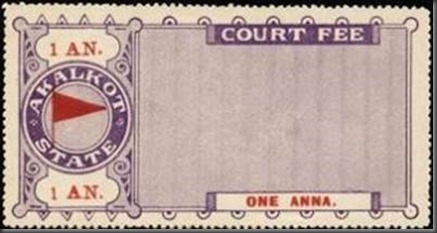
One of the earliest uses of revenue stamps was to pay Court Fees. Fiscal stamps were used in the Indian feudal states as early as 1797, almost 50 years before the first postal stamp, the Penny Black, appeared in 1840. Although India is only one of several countries that have used tax stamps on legal documents, it was one of the most prolific users. The process has its disadvantages due to the prevalence of forgeries, which costs the issuing government loss of revenue. Fig-1 shows a 1 anna Akalkot Court Fee stamp, mint. Mint stamps from Indian Princely states are rare.
clip_image004

Fig-1

Documents

The tax on documents, also commonly known as ‘stamp duty’, is one of the oldest uses of revenue stamps. Governments would enforce the payment of the tax by making unstamped documents not enforceable in court. The tax would apply to contracts, tenancy agreements, wills, etc. They could be in the form of stamp papers, embossed stamps, or adhesive stamps. Fig-2 shows an embossed revenue stamp on a cheque from the Princely State of Gwalior.

clip_image006

Fig-2

Receipts

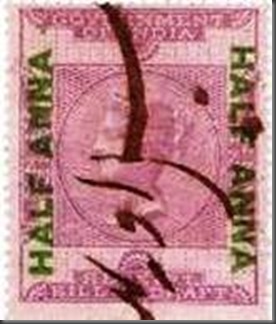
Receipt stamps are revenue stamps which were used as acknowledgement of various payments. Fig-3 depicts1861 British India receipt stamp surcharged HALF ANNA on 1 anna, Fig-4 Proofs of Alwar KM Type 31 imperforate & Dewas Junior state revenue stamp and Fig-5 St. shows Vincent bisected 3d revenue stamp
clip_image008

Fig-3

clip_image010

Fig-4

clip_image012

Fig-5

Tobacco and Alcohol

Tobacco and alcohol are taxed in many countries by the use of excise stamps. For instance, the producer may buy stamps from the government which are then affixed to each bottle of alcohol or packet of cigarettes, to show that tax has been paid. Often the stamp will be fixed across a seal so that on opening the pack or bottle the stamp is destroyed. Fig-6&7 show cigarette and wine tax stamps from U.S.A.

clip_image014 clip_image016

Fig-6                                                    Fig-7

Sales Tax

Some articles that required sales tax to be paid had a pre-paid tax stamp affixed to them. Fig-8 shows a sales-tax stamp of value 9 cents from the state of Ohio, USA.

clip_image018

Fig-8

Entertainment Fee

Entertainment fees were levied on various forms of entertainment by affixing stamps on the tickets. Fig-9 shows ½ anna entertainment tax stamp of Pudukkottai State.

clip_image020

Fig-9

Motor Vehicle Fee

Motor Vehicle Fee stamps were issued by Indore state to collect taxes from motor vehicles. Fig-10 shows Motor Vehicle Fee stamp of Indore, value 100 rupees.

clip_image022

Fig-10

Telephone Service

Special stamps were issued for the telephone and telegraph services. Fig-11 shows a 3 annas Patiala State Telephone Service stamp.

clip_image024

Fig-11

Share Transfer

British India had special stamps that were required to be fixed to share certificates when they were transferred from one person to another. Fig-12 shows an 8-anna and Fig-13 shows a 1-rupee share transfer stamp.


clip_image026   clip_image028

Fig-12                        Fig-13


Insurance Stamp

Insurance policies have special insurance stamps fixed on to them. Fig-14 shows a pair of King George V 2-annas insurance stamps and Fig-15 a post-independence 500-rupee.

clip_image030 clip_image032

Fig-14                   Fig-15

Special Types

Special types of revenue stamps were used in some Indian states. Sirmor used postal stationery with provisional overprint for court fees. Fig-16 shows Sirmor Postcard overprinted for use as 8-annas Court Fee.

clip_image034

Fig-16

Stamped Papers

Collecting stamped papers is part of revenue philately. Stamped paper refers to a foolscap piece of paper that bears a pre-printed revenue stamp. Stamped papers have been used around the world to collect taxes on documents requiring stamping, such as leases, agreements, receipts, court documents and many others. The papers are bought blank apart from the pre-printed stamp and are available from stationers, lawyer’s offices, post offices and court stamp vendors according to local regulations. The matter to be recorded is then written or typed on to the stamped paper and it is lodged with the court or other interested party. This is an efficient way of collecting taxes and stamping documents without the need to submit them to a separate government stamp office.

The 1765 Stamp Act required all British colonies in the New World to use stamped paper prepared in London and embossed with a revenue stamp. This led to riots and political agitation which has been credited with sowing the seeds of the American Revolution.

Stamped paper was actually a Spanish invention and was introduced into India in 1848 following the introduction of the Congreve printing machine. Prior to this, legal documents were written on paper that could vary from strong parchment of good quality to ordinary stationers’ material. The use of water-marked paper came later. Prolific users of stamped paper have included Great Britain, the United States and India.

clip_image036

Fig-17

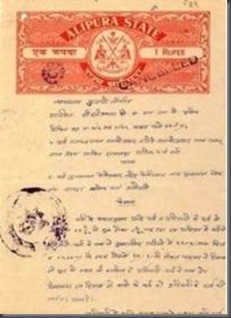
The stamp sometimes occupies the entire width of the top part of the paper and is often of an intricate engraved design in order to enhance security. The portrait of the ruling monarch was often part of the design. The paper frequently has a whole page watermark for the same reason. Figs-17&18 show British India King George V 12 Anna stamped paper used in 1938 & British India King George VI 150 rupees stamped paper used in 1943. Fig-19 shows 1934 5-rupee court fee stamp on 50 rupee Sangli State stamped paper and Figs-20&21 Bharatpur State 1anna stamp paper & Alipura State (India), stamped paper of 1900.

clip_image038             

Fig-18   

clip_image040

Fig-19

clip_image042     clip_image044

Fig-20                         Fig-21

Collecting revenue stamps and stamped papers is an interesting and fun-filled hobby. While the stamps themselves are interesting, we find collecting them on the original document much more interesting. Especially fiscal stamps from the Princely States of India make colorful and interesting collections.

References

1. A Koeppel, R.D Manners, Court Fee and Revenue Stamps of the Princely States of India, Volume I – The Adhesive Stamps, Minneola, New York, 1983.

2. A Koeppel, R.D Manners, Court Fee and Revenue Stamps of the Princely States of India, Supplement to Volume I, Minneola, New York, 1986.

3. A Koeppel, R.D Manners, Court Fee and Revenue Stamps of the Princely States of India, Volume II – The Fiscal Stamp Paper, Minneola, New York, 1989.

4. Clive Akerman, The Presentation of Revenue Stamps: Taxes and Duties in South America. New edition. The Revenue Society of Great Britain, 2002.

5. Adolph Koeppel, The Stamps that Caused the American Revolution, the stamps of the 1765 British Stamp Act for America, American Revolution Bicentennial Commission, New York, 1976.

6. Einstein, Joseph; Thomas C. Kingsley and W. Richard DeKay. Handbook for United States Revenue Stamped Paper, American Revenue Association, Inc., United States.

7. SM Blatt, AM.Mollah, DH Heppell, Indian Government Fiscal and Judicial Stamps & Stamp Papers, Vol. 2, Part 1, 2004.

8. Jiří Černý, Revenue Stamps of the Princely States of India, 2009.

clip_image002: Col Jayanta Dutta & Dr Anjali Dutta

email : doctorjayanta2009@gmail.com

Saturday, May 4, 2013

Stamps on 50 Bollywood Personalities


image


100 years of Indian Cinema

DELHI: President Pranab Mukherjee yesterday released commemorative postage stamps on the eve of 100 years of Indian Cinema depicting 50 iconic bollywood personalities including Dev Anand, Smita Patil and Yash Chopra. "Six Miniature Sheets depicting 50 iconic personalities of Indian Cinema to commemorate this century long journey" were released by the President, according an official statement by Department of Posts.

cinema

"This issue of 50 stamps is the biggest issue to commemorate an occasion by India Post," the statement said.
First two Mini-sheets comprising nine stamps, depict some Dadasaheb Phalke awardees and rest four with eight stamps each depict personalities from various fields of cinema.

"The personalities depicted in Stamps include, Ashok Kumar, Bhalji Pendharkar, Durga Khote, Dev Annad, Yash Chopra, Smita Patil, Rajesh Khanna, Shammi Kapoor, Suraiya, Geeta Dutt, Sohrab Modi, Tapan Sinha, CV Sridhar, Bhanumathi etc.," the statement said.


India's first full length feature film Raja Harishchandra by Dada Saheb Phalke was released on May 3, 1913.

These stamps will be made available for sale to all Philatelic Bureaux in the month of June 2013. First two Miniature Sheets consist of nine stamps each and depicts some Dadasaheb Phalke awardees. The other four with eight stamps each depict personalities from various fields of cinema. The denomination of each Stamp is Rs. 5/-. Single stamp sheets are not being issued/ printed.

Notification For Commemorative Postage Stamps on 100 Years of Indian Cinema


2. The details of above issue are as follows:-


i. Six Miniature Sheets with a print order of 8.1 Lakhs each are being issued. First two Miniature Sheets consist of nine stamps each and depict some Dadasaheb Phalke awardees. The other four with eight stamps each depict personalities from various fields of cinema.


ii. The denomination of each Stamp is Rs. 5. Single stamp sheets are not being issued/ printed.


iii. Sufficient numbers of First Day Covers and Information Brochures will be available for sale with the stamps at the Philatelic Bureaux.

 
iv. First Day of Cancellation will be available for six months from the date of release as a special case.


v. The images of the stamps will be uploaded on the India Post website after release.


3. The date from which these stamps will be available for sale at the Philatelic Bureaux shall be intimated on India Post website in due course.

Here is the complete list of film personalities.

M/S No. 1: Ashok Kumar, Bhalji Pendharkar, Dhirendranath Ganguly, B. N. Sirkar, Bhupen Hazarika, Durga Khote, B. R. Chopra, Dev Anand and Hrishikesh Mukherjee.

M/S No. 2: Majrooh Sultanpuri, Naushad, Nitin Bose, Prithviraj Kapoor, Raichand Boral, Ruby Myers, Sohrab Modi, Tapan Sinha and Yash Chopra.

M/S No. 3: Allu Ramalingiah, Balraj Sahni, C.V. Sridhar, Kamaal Amrohi, Ashok Mehta, Bhanumathi, Chetan Anand and Geeta Dutt.

M/S No. 4: Kannadasan, Mehmood, Nagesh, Prem Nazir, Madan Mohan, Motilal, O. P. Nayyar and R. D. Burman.

M/S No. 5: Raj Khosla, Rajesh Khanna, Salil Chowdhury, Shailendra, Rajendra Kumar, S. V. Ranga Rao, Sanjeev Kumar and Shakeel Badayuni.

M/S No. 6: Shammi Kapoor, Smita Patil, Tarachand Barjatya, Utpal Dutt, Shankar Jaikishan, Suraiya, T. R. Sundaram and Vishnu Vardhan.

Thursday, April 25, 2013

Letter Box or Dustbin ??


image

Letter Box used as dustbin in Nainital. Photo taken by Atul Agarwal, a philatelist from Aligarh who recently visited Nainital. While walking on the Mall Road, near the Library He found the letter box which has been used as dustbin, instead of a letter box. Shame on India Post …

Is this the future of Postal Department in India ?

image


image

Tuesday, April 23, 2013

Discussion - Definitive stamps of India


image

Some more comments received from the members…


BIBHU MISHRA, Bhubaneshwar

“The current issue under discussion is very much relevant…………... It is not only definitive but the commemorative stamps printed are of poor quality………. Comparing with other countries, the stamps produced in India are of lower quality & less attractive. While finalising proposal of stamp issue, no body consults the essential aspects that enrich the beauty of the stamps. Stereotype ideas are generated which reduce the interest of ( the people and ) collectors. As we know, Stamps are ambassador of a country’s progress; it is duty of stamp collectors to raise voice with constructive ideas for better and attractive postage stamps on different unexplored areas.”


MANSOOR B., Mangalore

“I had written about the deteriorating quality of Indian definitive stamps comparing to other countries…………….our stamps are identified as definitives, just by their (poor) quality. There may be reasons behind this such as, these are meant for the common man and common man does not notice the quality. But they represent the country at large before the world.  Is it (not) affordable to the Dept of Posts to use better quality paper and printing for definitives………………What is the costing to print a Rs.2/- definitive stamp?”


K.RAMARATHNAM, Chennai

"Definitive Stamps are the most neglected by all the concerned, be the designer, printer or the issuer, that is Postal department. No thought is given at the design stage. Just as Royal Mail has the Silhouette of Queen as the basis and has evolved their definitives around it, we could also adopt the Silhouette of Gandhiji as basic design and develop the definitive stamps around it. Gandhi is a loved topic for Philatelists all over the world, and would be welcomed.
The (present) Paper and the Adhesive used are of poor quality, I would not say they are sub-standard, but the standards set are abnormally low. There is need to revise the basic specifications for definitive stamps of India including paper and adhesives”


Prof. SAHADEV SAHOO , Bhubaneshwar

“Last minute decisions to issue stamps under pressure leads to bad quality and ill-designed stamps. The quality has to suffer if we do not give weightage to right choice of themes and (do not) provide adequate time for designing and printing.”


SUDHIR JAIN,Satna (MP)

“ If Multicolour printing of stamp on fine paper involves high cost, Single colour printing can also be made attractive by improving quality of printing and quality of paper.”


DINESH CHANDRA SHARMA, Lucknow

“In every Philatelic exhibition whether District, State or National, the Department of Posts officials generally add in their speech that the Postage stamps are tiny ambassadors of our nation. Have they ever thought what kind of ambassadors are travelling on our letters and parcels to other countries and what kind of image they are portraying about our nation ?

The poor quality of our definitive stamp issues not only put the question mark on the attitude of officials of Department of Posts but also shows the poor functioning of Philatelic Advisory Committee (PAC) …………..The members of PAC need to be creative, responsible and courageous enough to oppose anything (that is) not up to the mark and to bring new ideas or concepts. Particularly, members representing philatelic fraternity have much bigger responsibility as they understand the esthetic as well as philatelic value of stamps and other philatelic products, better.

The difference in the cost of production will not be much as per my experience of handling the production of stamps too. It is simply a matter of Policy of Department of Posts as if it wants to portray Indian image in a better way or not.”


Saturday, April 6, 2013

Discussion - Definitive stamps of India


image

Dear Friends,

Recently we have received a mail from our member Pradeep Kumar Mallik from Patna, along with some shocking attachments regarding Indian Definitive stamps, taken from and published in Market Tipster Column of the Glen Stephens Monthly "Stamp News”, March 2013 issue. The comments made for the current Indian definitive stamps are read as follow :

“ Indian modern definitive stamps are often just woeful, for a country that is very keen to (be) taken seriously as a leading and emerging nation.”

“ Current India high value definitives look like they were produced by a half blind forger, using a 1980s laser printer near out of ink, and a blunt

nail to perforate them. Washed out colours, very crudely printed and screened, coarsely perforated, and on horrible cheap paper.”

“.............heavy overseas parcels seem to be wallpapered with Indian definitive stamps! High value current stamps used on overseas parcels

Showcase nation to the world, and the message these stamps send about India is VERY negative.”

“ I suspect anyone with access to a photocopier can forge better looking copies of these than the PO sells, so why some effort is not made

to print them professionally, is a mystery.”

“ Surely there are printers in India who can if they wish, replicate almost anything the West can produce”

All these comments with eye-opening illustrations can be seen using the following link:

http://www.glenstephens.com/snmarch13.html

This is shocking and indeed very shameful situation for us first as Indians and then as philatelists. Why did not we ourselves realise this?

Now, the point for our discussion regarding this important issue is as follows :

“ Is not it important and necessary for India Post to produce the definitive stamps on fine quality paper with latest

printing technologies and attractive designs ? Is the Department of Post doing right in projecting a dismal picture

of the country by producing poor quality stamps, which showcase India’s capabilities before the world ? ”

Here are some views / comments received from the members….


Madan Middha

Editor : Discussions

Philatelic Journalists Forum.


RESPONSES

Naresh Agarwal - Bilaspur

“I felt very bad……… But then I cooled and controlled my emotions, looking in to the genuineness of the facts narrated. Undoubtedly, the quality of the Indian definitives is very poor, may it be paper, ink, printing, perforation or else.……..We must not forget that stamps are ambassador of the country. It is not only the subject matter which counts but stamp, as a piece in totality, represent a country. It is a mirror... but mirror needs to be clean and clear. There is urgent need to look in to this matter and INDIA POST should take immediate steps to improve this.”


Vijay Seth – New Delhi 

“We are not happy with the stamp designs, paper and, the list is quite long, let us all make our efforts on a common cause, I am sure we can bring a change…………….Persistence pays in the long run if you are working with a selfless motive……….…..I am willing to start a signature campaign on, (to) improve the designs and be firm on date of issue, stop personality worship, it has now become a  cult in India Post…………..we have over a crore Devis and Devtas, let us worship them in private…………….we as a nation on many occasions have ended up being a laughing stock in front of ,many nations. Let us bring an end to this…………”      


Rajesh Paharia - Jaipur

“It is indeed a good point of discussion since Postage stamps are considered as ambassadors of nation…………poorly produced stamps definitely portray bad image of the country.

But before going into it, does anybody have data and knowledge about cost of production and difference between the costs for good and poorly printed stamps. In order to discard the ( possible ) unacceptable reason of higher cost of production , we need to have this backup.”


Dr Avinash B. Jagtap - Switzerland


“There is nothing "surprising" or "shocking" what Mr. Glen Stephens of  "Stamp News" has to say about Indian Definitives.……………Also it is not clear, why India Post does not ask the opinion of the stamp collectors in India on the issue of the theme, which will  appeal to the stamp collectors at home and also abroad? In fact in Europe the respective philatelic bureaux do carry out an opinion pool to fix their strategy as regards the theme for their definitives. etc…………..Apart from it one should logically think that a definitive stamp of  Rs. 10 or 20, should appear large sized, with superb printing and the paper on which it is printed must be of a better grade than a commemorative stamp ………..”

“It is but very natural that when a person from outside criticizes the quality of India definitive stamps, we in India feel ourselves insulted. The question is: What the members, who decorate the chairs of the committee, which decides the fate of definitives do…………….. At present the decision making committee of India Post, which is responsible for the definitive stamps, is like a Step-Mother and the definitive stamps are her shabby and neglected children. What else one could say? I only wish and hope that your appeal will be heard at the upper level.”


Ajay Kumar Mittal – New  Delhi

“It is really a serious and important matter………….and should be discussed and get the view points from other concerned. I fully agree with the opinion that India Post should look into the matter and give a serious thought to this. Stamps are the paper ambassador of a country……………….. Countries like Japan, Australia, China and many others are producing very attractive definitive stamps. In present situations when use of stamps on letters is already reduced drastically……………. at least what we are producing should be attractive and of better quality. The quality of stamps which we are getting now is nowhere near our expectations. Quality checks at security printers are also not taken care of; you can find errors such as colour missing, perforation missing, paper folds, half printing, perforation shift or mis-perfs…………………….at philatelic exhibitions these varieties are exhibited by collectors. Now it is high time to give a serious thought and as true Indian we should approach appropriate authorities in India Post and Security printers to do the needful.”


Ilyas Patel -  Ahmadabad

“It is neither an acceptable nor a palatable point for India Post. First; whether India Post is ready to listen to such issues? Second; is there any responsible person in DOP to listen to this and attend seriously? Third; who is responsible for this?...................... Whatever points raised to India Post, they don't care to even reply. Then what is the meaning for all these discussions?..................I personally feel that it is a futile exercise. Prior to this, several issues have been raised in various philatelic journals and columns but in vain…………..Anyways, it is good for philatelists, to learn more with such debate.”